1


Stay in Touch
Get the latest updates, special offers, and exclusive Cinchy perks straight to your inbox.


Jl. Plawa No.50, Seminyak, Kec. Kuta, Kabupaten Badung, Bali 80361

CALL US 24/7
(+62-851-7424-6249)
Copied!

We’re Here
Everyday
8:30 AM-9 PM WITA




Payment Partners


© 2026 CINCHY. ALL RIGHTS RESERVED.
Cinchy Blog / Bali vs Singapore: The Comparisons of Two Southeast Asian Islands
Published: 15 Apr 2026

By Ulfah Alifah
Travel Enthusiast
Free Cancellation
24/7 Support
Insurance
Start Date - End Date
Start Time
End Time
Duration
0 Day(s)
Planning a trip to Southeast Asia and stuck choosing between Bali and Singapore? You are not alone. These two islands are among the most visited destinations in the entire region, yet they could not be more different. One is a lush, spiritual tropical escape. The other is a sleek, ultra-modern city-state.
This guide breaks them down side by side — honestly and in full detail — so you can decide which island fits your travel style, your budget, and your goals.
Bali is a tropical island and province of Indonesia, covering about 5,780 square kilometers. It sits in the Lesser Sunda Islands and is famous for its white-sand beaches, volcanic mountains, ancient Hindu temples, and world-renowned surf breaks. Tourism makes up nearly 90% of the island's economy, which means every corner of the island is set up to welcome visitors.
You can find everything here — luxury private-pool villas at $1,000+ USD per night, or a cheap surf guesthouse for $20 a night. Bali works for every budget. The Balinese people are known worldwide for their warm hospitality and rich cultural traditions. It is the only Hindu enclave in the predominantly Muslim nation of Indonesia, giving it a completely unique spiritual identity.
Popular areas include Seminyak and Kuta for nightlife and beaches, Ubud for yoga and culture, Canggu for digital nomads and surfers, and Uluwatu for clifftop temples and epic sunsets. If you want to plan your route, check out the complete Bali itinerary guide on Cinchy to help map out every day of your trip.
Singapore is a city-state and island nation of about 757 square kilometers, making it one of the smallest countries in the world. Despite its size, it is one of the wealthiest nations per capita on the planet. It borders Malaysia and sits at the southern tip of the Malay Peninsula, serving as one of the world's most important trade and financial hubs.
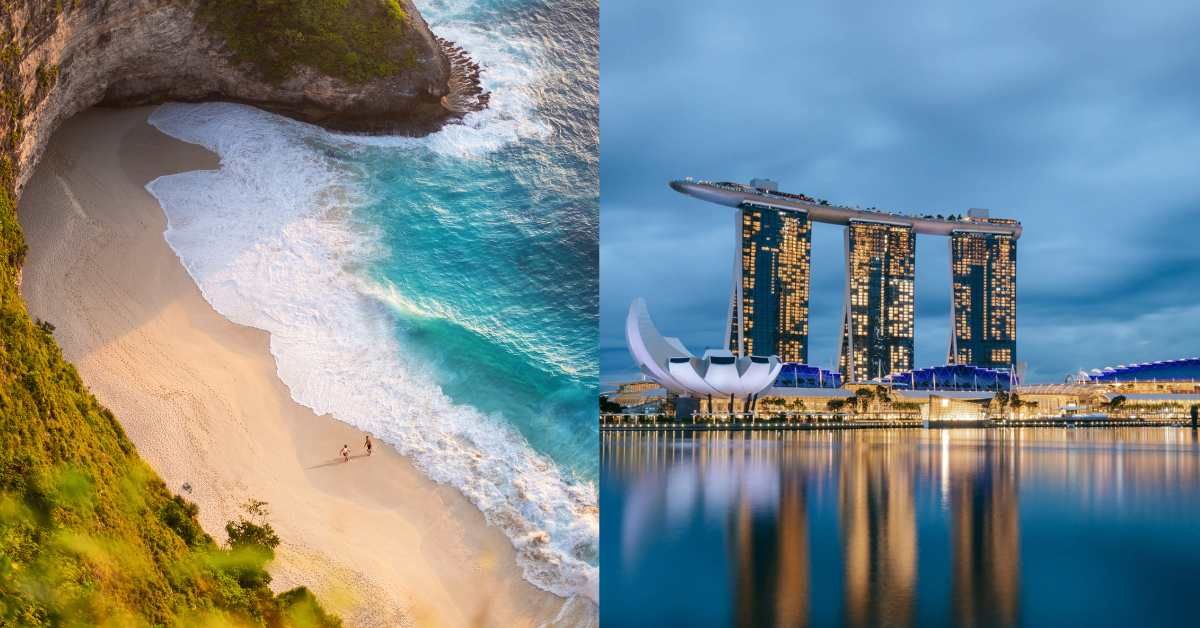
The country is famous for its futuristic skyline, immaculate streets, and multicultural neighborhoods. From the colourful streets of Little India to the food stalls of Chinatown, Singapore packs enormous cultural variety into a very small area. Attractions like Marina Bay Sands, Gardens by the Bay, and Sentosa Island have made Singapore a destination in its own right — not just a layover stop anymore.
Singapore is known for strict laws and world-class infrastructure. Everything works. The MRT trains run on time, the food is world-class, and the city is effortlessly clean and safe. It is an ideal base for first-time travellers to Asia who want comfort and convenience from day one.
Singapore's beaches are mostly found on Sentosa Island. They are clean, well-maintained, and good for a relaxed day out. However, many of the beaches are man-made or modified, and they do not carry the natural drama you expect from a Southeast Asian beach destination.
Bali is a completely different story. The island is home to some of the most photographed beaches in the world. Kuta and Legian are great for beginner surfers. Seminyak and Petitenget offer upscale beach lounging. Nusa Dua is famous for its calm, crystal-clear waters ideal for families. Uluwatu delivers dramatic cliff-lined beaches for experienced surfers. Bali wins this category without question.
Singapore does offer water sports — scuba diving, surfing, jet skiing, and kite surfing are all available, especially if you head offshore. The marine life around the island is decent, and the facilities are professional. The problem is cost. Everything in Singapore comes with a premium price tag, and water sports equipment hire is no exception.
Bali, on the other hand, is a playground for water sport lovers. Tanjung Benoa in Nusa Dua is a hub for parasailing, wakeboarding, and banana boat rides. Canggu and Uluwatu are globally recognized surf breaks. Tulamben on the northeast coast offers world-class wreck diving at the USAT Liberty shipwreck. Nusa Penida is famous for swimming with manta rays. You can experience all of this at a fraction of what it would cost in Singapore.
The best way to get between these surf spots is by scooter. Read the step-by-step guide to renting a scooter in Bali before you hit the road.
Bali is considered a very safe destination. Crime rates are low, and the vast majority of visitors experience nothing more serious than petty theft or the occasional traffic issue. Minor risks like tropical diseases exist, but they are manageable with basic precautions.
Singapore, however, is consistently ranked as one of the safest cities and countries on Earth. Laws are strict and rigorously enforced. Crime is rare. The police force is strong, and public health standards are exceptionally high. If personal safety is your top priority, Singapore wins this category clearly.
Singapore is packed with well-known attractions: Universal Studios, Gardens by the Bay, the Merlion Park waterfront, Singapore Zoo, Madame Tussauds, the Civic District, and vibrant cultural neighbourhoods. It is a very polished, well-organised destination.
Bali, however, offers far greater variety. You can climb Mount Batur at sunrise, walk through the Sacred Monkey Forest in Ubud, visit over 10,000 Hindu temples, explore the rice terraces of Tegallalang, spot rare birds at West Bali National Park, or watch a traditional Kecak fire dance at Uluwatu.
If you are spending time in the Canggu area, read the full guide on the best things to do in Canggu — it is one of Bali's fastest-growing hotspots and has something for everyone.
Singapore has a nightlife scene centred around Clarke Quay and Marina Bay. Clubs are professional and well-run, but they are also expensive. Drinks are pricey, cover charges add up fast, and the scene is smaller than you might expect from a city of its size.
Bali is famous around the world for its nightlife. Seminyak is home to stylish rooftop bars and sunset cocktail spots. Canggu draws a younger, creative crowd. Kuta stays loud and busy until dawn. Beach clubs across the island offer a uniquely Balinese party atmosphere with live DJs, pool access, and ocean views. There is always a party in Bali, and it does not cost a fortune to enjoy.
Singapore became a sovereign nation in 1965. While it makes great use of its multicultural heritage — blending Chinese, Malay, and Indian influences across its neighbourhoods — its cultural history is relatively short. Little India, Chinatown, and Kampong Glam are fascinating areas to explore, but they represent a recent story.
Bali has been continuously inhabited for thousands of years and carries one of the most distinctive living cultures in all of Asia. It is the island of the gods — home to daily offerings, vibrant ceremonies, traditional dances, and an intricate Hindu spiritual life unlike anything else on Earth. The annual Nyepi (Day of Silence) festival and the dramatic Ogoh-ogoh parade are just two examples of cultural events that are completely unique to Bali. Culture lovers will find far more depth here.
Singapore's hawker centre culture is legendary. Hainanese chicken rice, chilli crab, laksa, fish head curry, and char kway teow are just a few of the dishes that have put Singapore's street food scene on the global map. Some hawker stalls have even earned Michelin recognition. Prices at hawker centres remain surprisingly affordable despite the city's overall cost of living.
Bali also has a rich culinary tradition. As the only Hindu island in the archipelago, pork is a celebrated part of Balinese cuisine — unusual in this part of Indonesia. Babi guling (suckling pig), nasi goreng (fried rice), sate lilit (Balinese satay), and nasi campur (mixed rice) are must-try dishes. Fresh seafood in areas like Jimbaran is outstanding.
This category is a genuine tie. Both destinations offer incredible food experiences at their respective price points.
Singapore's cityscape is stunning — the Marina Bay skyline at night, the futuristic Supertrees at Gardens by the Bay, and the sleek architectural contrasts across the city make it highly photogenic.
Bali does not compete with Singapore on urban design, and it does not need to. Rice terraces cascading down hillsides, jungle waterfalls hidden behind winding paths, volcanic peaks looming over the horizon, and blood-orange sunsets over the Indian Ocean — Bali wins the aesthetics category on natural beauty alone.
Singapore is roughly three times more expensive than Bali across nearly every category — restaurants, groceries, transport, and accommodation. A 1-bedroom apartment in Bali's city centre rents for around $1,300–1,400 USD per month, while the same in Singapore would cost $3,900–4,100 USD per month.
You could spend a week in Bali staying at a luxury private villa, enjoying daily spa treatments, dining at top restaurants, and surfing every morning — for the same cost as a long weekend in a mid-range Singapore hotel. Bali wins this category decisively.
To get around Bali cheaply and efficiently, renting a scooter is the best move. See the scooter rental costs in Bali explained by Cinchy before you book.
Bali is a brilliant place to shop if you are looking for unique handmade goods — Balinese wood carvings, silver jewellery, batik textiles, hand-woven fabrics, and local artwork fill the markets of Ubud and the boutiques of Seminyak. Bargaining is expected and part of the fun.
Singapore, however, is a world-class shopping destination. Orchard Road is lined with international luxury brands. The malls at Marina Bay and Bugis Street cater to every taste and budget. Singapore wins this category, especially for shoppers looking for global brands or electronics.
Bali is one of the most popular digital nomad hubs on the planet. The Canggu and Ubud areas are packed with co-working spaces, fast Wi-Fi cafés, and a large international nomad community. Indonesia now offers a Digital Nomad Visa (E33G) allowing longer stays for remote workers. The cost of living is low, the lifestyle is excellent, and the community is welcoming.
Singapore offers world-class infrastructure and a strong startup ecosystem, but it is far too expensive for the average digital nomad. Most nationals are only permitted to stay 30 days without a visa, which makes long-term nomadic life logistically difficult. Bali wins this category by a wide margin.
If you are planning to explore Bali as a nomad, having a reliable scooter is essential. Check out the best scooter rentals at Bali Airport to get set up right from landing.
Singapore has long attracted expats in finance, banking, and tech. Salaries are high, the rule of law is strong, and English is widely spoken. The standard of living is excellent for those with well-paying jobs.
Bali attracts a different type of expat — retirees, artists, wellness practitioners, and remote workers. The cost of living is low, quality of life is high, and the island is easy to settle into for long-term stays. For those without a Singapore salary to draw on, Bali is far more accessible. This category is a tie — it depends entirely on your profession and lifestyle needs.
Bali is genuinely budget-friendly. A backpacker can live comfortably in Bali for $30–60 USD per day, covering accommodation, meals, transport, and activities. Mid-range travellers spending $60–150 USD per day will enjoy solid hotels, fine dining, and day trips. Luxury travellers can access world-class resorts and private villas on $150–500+ USD per day.
Singapore requires significantly more. Budget travellers should expect to spend $80–120 USD per day minimum. Mid-range travellers typically spend $150–300 USD per day. Luxury stays in Singapore's top hotels can exceed $500–700 USD per night alone. Singapore is not the place to stretch a tight travel budget.
Singapore is a compact city-state, and most of its key attractions can be covered in three to four focused days. You can see the main sights, eat your way through the hawker centres, and explore the cultural neighbourhoods comfortably in a long weekend.
Bali is a much larger island, and doing it justice takes at least five to seven days. A proper exploration of Bali — covering the south beaches, Ubud's cultural heart, the north and east, and maybe a day trip to Nusa Penida — would ideally take ten days or more. Most visitors feel they have not seen enough, even after a week.
Most international travellers enter Bali visa-free for 30 days, with the option to extend via a Visa on Arrival (VOA) for another 30 days at a cost of around 500,000 IDR. Since 2025, all arrivals must complete the All Indonesia Arrival Card digitally before landing — this combines immigration, customs, and health declarations into one digital form.
Singapore offers visa-free entry to most Western and Asian nationalities for 30–90 days depending on passport. The entry process is streamlined, especially at Changi Airport, which is consistently ranked among the world's best airports.
Bali's Ngurah Rai International Airport (DPS) in Denpasar is a major regional hub with direct connections across Asia, Australia, the Middle East, and some European cities. Low-cost carriers operate frequent routes from nearby hubs. Once you land, pick up a scooter straight from the airport — see the Cinchy Airport scooter rental guide for the easiest way to get moving from day one.
Singapore's Changi Airport (SIN) is regularly voted the world's best airport. It connects to over 100 countries and serves as a major transit hub between Europe, Asia, and Oceania. Connectivity in and out of Singapore is arguably the best in the entire region. Changi alone is worth a few hours of your time.
Bali is one of the most romantic destinations on Earth. Watching the sunset from the sea temple of Tanah Lot, sharing a private candlelit dinner in a rice terrace restaurant in Ubud, taking a couples' massage at a hillside spa, or watching a Kecak fire dance at Uluwatu as the sun drops into the ocean — these are genuinely unforgettable moments.
Singapore's romance comes in a different form. The Marina Bay Sands rooftop infinity pool at sunset, a stroll through Gardens by the Bay during the nightly Supertree light show, or a private cable car ride to Sentosa Island all offer a sophisticated urban version of romance. Both islands are romantic — they just deliver that feeling in very different ways.
Bali leads the world in honeymoon-worthy accommodation. Private pool villas in Seminyak allow you to have your own slice of paradise completely to yourselves. Nusa Dua's luxury beach resorts offer all-inclusive pampering with direct beach access. Jungle retreats in Ubud put you above the rice terraces with open-air bathrooms and forest views.
Singapore offers iconic honeymoon hotels like Marina Bay Sands, Capella Singapore on Sentosa Island, and the historic Raffles Hotel — a colonial-era landmark that oozes old-world luxury. The choice comes down to whether you want nature and seclusion or glamour and urbanity.
For honeymooners in Bali, a sunrise hike up Mount Batur followed by a private breakfast above the clouds is an experience you will never forget. Private cooking classes, romantic beach dinners, balinese blessing ceremonies for couples, and island-hopping trips to Nusa Penida all make for a deeply personal and memorable honeymoon.
In Singapore, honeymooners can enjoy rooftop cocktails with city views, fine dining at Michelin-starred restaurants, a visit to the Singapore Botanic Gardens (a UNESCO World Heritage Site), and a luxury shopping spree on Orchard Road. It is effortlessly convenient and indulgent.
Singapore's top attractions include:
Bali's top attractions include:
Both destinations pack a remarkable number of sights into their respective sizes.
If you're exploring areas like Seminyak and want the flexibility to get to all of Bali's top spots quickly, check out the Cinchy scooter rental guide for Seminyak — it covers everything you need to know.
When you put it all to a score, Bali wins more head-to-head categories than Singapore. Bali takes beaches, water sports, things to do, nightlife, culture, aesthetics, value for money, and digital nomad appeal. Singapore wins safety and shopping. Food and expat suitability are a tie.
That does not mean Singapore is not worth visiting — it absolutely is. But for most travellers, especially those visiting Southeast Asia for the first time or seeking a mix of adventure, culture, and value, Bali will deliver more. If you have the time, do both. They complement each other beautifully — fly into Singapore, spend a few polished days in the city, then escape to the warmth and soul of Bali for the real tropical experience.
For your Bali adventure, whether you are a solo traveller, a couple, a digital nomad, or a family — start by exploring all the options at Cinchy Life and get ready to make the most of the island.
For most travellers, Bali offers more overall — better beaches, more activities, richer culture, more vibrant nightlife, and far better value for money. Singapore is a world-class destination but appeals more to city lovers, shoppers, and those who prefer safety and structure above all else. If you can only pick one for a holiday, Bali wins for the majority of travellers. If you have extra time and budget, combining both islands in one trip is highly recommended.
Singapore is dramatically more expensive. The cost of living in Bali is around 65% less than Singapore. Restaurants in Singapore cost about twice as much as in Bali, transport costs five times more, and housing is roughly two and a half times the price. Budget travellers will find Bali significantly more accessible, and even luxury travellers will find their money stretches much further on the island.
Absolutely yes. Bali remains one of the most rewarding travel destinations on the planet. Despite growing tourist numbers, the island continues to offer a compelling mix of natural beauty, spiritual culture, outstanding food, and incredible value. New areas like Canggu continue to develop without losing what makes the island special. Bali is evolving to meet the demands of modern travel, and it is doing so well. Whether you are coming for the surf, the temples, the food, or the nightlife — Bali delivers.
No. Singapore is significantly smaller than Bali. Bali covers approximately 5,780 square kilometers, while Singapore covers only around 757 square kilometers. This means Bali is nearly eight times larger than Singapore. You can travel across Singapore in a single day, while fully exploring Bali — from Kuta's beaches in the south to Lovina's black-sand shores in the north — takes many more days.
Bali's dry season runs from May to October, making those months ideal for beach trips and outdoor activities. May is a particularly sweet spot — the dry season has just begun, crowds are lighter than peak mid-year, and flight and hotel prices are still reasonable. That said, Bali receives roughly eight hours of sunshine per day even during the wet season (November to April), so there is genuinely no bad time to visit. April is also a great time to go — you can read more in the Bali April travel planning guide on the Cinchy blog.
Bali is excellent for families. Children are warmly embraced by Balinese culture — it is common to see hotel staff genuinely playing with and entertaining guests' children. Waterbom Bali (one of Asia's best waterparks), the Sacred Monkey Forest, and beach days at Nusa Dua are all hugely popular with kids. Singapore is also very family-friendly with well-organised, child-specific attractions like the Singapore Zoo, the Science Centre, Universal Studios, and KidZania. For families who want a relaxed pace, Bali edges ahead. For highly structured, activity-packed family fun, Singapore delivers extremely well.
It depends heavily on your departure city. Flights from Australia are generally cheaper to Bali, which has direct routes from Sydney, Melbourne, and Brisbane. From Europe or the US, Singapore often offers better-connected routes and competitive pricing, especially as a hub airport. Changi Airport (Singapore) handles far more international carriers than Ngurah Rai (Bali), so for certain origins, Singapore may be the cheaper entry point into the region — and from there, an onward flight to Bali is typically inexpensive and short (around 2.5 hours).
Ready to explore Bali? Whether this is your first visit or your tenth, the island never runs out of things to surprise you. Start planning your trip with Cinchy and hit the ground running.
Want to get around Bali like a local and reach every hidden beach, temple, and surf break on your list? Book your scooter with Cinchy — fast, reliable, and delivered straight to your door or hotel.
Sources used in this article include comparative cost data , regional travel guides , and up-to-date entry and visa requirements for 2026 .
 travel tips
 hidden gems
 scooter guides
 riding tips
 bali guides
 cultural insight