
1


Stay in Touch
Get the latest updates, special offers, and exclusive Cinchy perks straight to your inbox.


Jl. Plawa No.50, Seminyak, Kec. Kuta, Kabupaten Badung, Bali 80361

CALL US 24/7
(+62-851-7424-6249)
Copied!

We’re Here
Everyday
8:30 AM-9 PM WITA




Payment Partners


© 2026 CINCHY. ALL RIGHTS RESERVED.
Cinchy Blog / Bali Airport to Ubud: Common & Shortcut Ways
Published: 08 Aug 2026

By Syahrial Maulana Sudarto
Travel Enthusiast

Quick Answer
“How can I go from Bali airport to Ubud by scooter?”
Traveling from Bali Airport to Ubud by scooter usually takes around 1.5–2.5 hours, depending on traffic, weather, and your exact destination in Ubud. The common route passes through Denpasar, Batubulan, Sukawati, and Mas, while alternative roads can sometimes help riders avoid congested sections and reach Ubud more efficiently.
Free Cancellation
24/7 Support
Insurance
Start Date - End Date
Start Time
End Time
Duration
0 Day(s)
Key Takeaways:
The road distance from I Gusti Ngurah Rai International Airport (DPS) to Ubud is roughly 35–40 kilometers, depending on where you are staying in Ubud and which route you take.
The distance may look short on a map, but don't expect the journey to take only 30 or 40 minutes.
Bali does not have a direct highway connecting the airport with Ubud, so much of the journey takes place on busy urban and local roads.
Under lighter traffic conditions, the journey can take around 75–90 minutes. During busy periods, however, the same route can take two hours or longer.
Current route guides identify the late afternoon period, particularly around 4 PM to 7 PM, as one of the more congested times for the journey.
For scooter riders, this difference matters. A route that looks slightly longer on Google Maps may actually be faster if it avoids a major traffic bottleneck.
The most common route from Bali Airport to Ubud generally heads north from the airport through South Bali before continuing toward Gianyar and Ubud.
The exact streets can change depending on traffic, but the general route is:
Bali Airport → Bypass Ngurah Rai → Denpasar → Batubulan → Sukawati → Mas → Ubud
This is the route you are most likely to see when checking directions from the airport to central Ubud.
If you're still uncertain about your next steps, don't worry, as we're here to address all your queries and concerns.
The road distance is approximately 35–40 km, depending on your destination in Ubud and the route selected. The journey usually takes around 1.5–2.5 hours, although heavy traffic can make it longer.
The most common route generally follows Bypass Ngurah Rai → Denpasar → Batubulan → Sukawati → Mas → Ubud. The exact roads may change depending on current traffic conditions.
There is no single shortcut that is always faster. Alternative routes around the Ida Bagus Mantra Bypass and Gianyar can help bypass congested sections of the common route when traffic is particularly heavy.
Yes. Cinchy offers free scooter delivery and pickup at I Gusti Ngurah Rai International Airport, allowing you to arrange your scooter before your trip and receive it at the airport.
For everyday riding, Cinchy's Compact category includes Honda Scoopy, Yamaha Fazzio, and Honda Vario. If you prefer a larger scooter for longer journeys, the Comfort category includes Yamaha NMAX and Honda PCX.
After leaving the airport area, the route connects with Jalan Bypass Ngurah Rai, one of the main roads serving southern Bali.
This section can be relatively straightforward outside busy periods. However, traffic can start building as you approach the wider Denpasar area.
For scooter riders, this is also where you should become more cautious about lane changes and surrounding traffic. The road can be busy, particularly during peak travel hours.
From the southern part of Bali, the common route continues toward Denpasar.
This is often one of the less enjoyable parts of the journey because you're moving through a heavily developed area rather than the quieter scenery associated with Ubud.
Traffic lights, intersections, local traffic, and large numbers of scooters can make your average speed much lower than expected.
If Google Maps shows a significant traffic delay in this section, this is usually the point where checking an alternative route becomes worthwhile.
After passing through Denpasar, the route continues north toward Batubulan.
Batubulan is an important point on the journey because the surroundings gradually become less urban as you move toward Gianyar.
However, this doesn't mean the road will automatically be quiet. Traffic can still be heavy, especially when many travelers are heading toward Ubud at the same time.
From Batubulan, the common route continues toward Sukawati, an area well known for its traditional markets and arts scene.
This section brings you closer to Ubud, but traffic can still fluctuate significantly.
If you're riding a scooter, keep an eye on your navigation app rather than assuming the main road will always be the fastest option. A few additional kilometers on a less congested road can sometimes be preferable to sitting in slow-moving traffic.
The route then continues toward Mas, a village south of central Ubud that is particularly associated with traditional wood carving.
From here, you're getting much closer to Ubud.
The road becomes more characteristic of the Bali many visitors expect to see—local communities, temples, small shops, rice fields, and narrower roads begin replacing the more urban landscape around Denpasar.
From Mas, continue north toward central Ubud.
Your final route will depend on where your accommodation is located. Ubud isn't a single point, so reaching a hotel around Monkey Forest, Ubud Palace, Sayan, Penestanan, or northern Ubud can require different final turns.
This is why the exact destination on your navigation app matters. Two travelers can both say they're going to Ubud but receive noticeably different routes based on their accommodation.
The common route is not necessarily the fastest route at every hour of the day.
Bali's traffic is highly variable. A road that takes 20 minutes in the morning can become heavily congested later in the afternoon. Rain, roadworks, accidents, local ceremonies, and temporary road closures can also affect the journey.
Current route information puts the typical Bali Airport–Ubud journey at around 75–120 minutes, with longer travel times possible during heavy congestion.
This is where shortcut routes become useful.
Rather than thinking of a shortcut as one secret road that is always faster, it's better to think of it as an alternative route used to bypass a specific traffic problem.
For scooter riders, this can be especially useful because a scooter can often navigate smaller public roads that aren't practical for larger vehicles.
However, you should never choose a road simply because it looks shorter on the map. Make sure the road is publicly accessible, suitable for scooters, and safe to ride.
The best shortcut from Bali Airport to Ubud depends on where traffic is building up.
Instead of following the main route through Denpasar all the way to Ubud, scooter riders can sometimes use alternative roads around Ida Bagus Mantra, Batubulan, Sukawati, and Gianyar to bypass slower sections.
There is no single shortcut that is guaranteed to be faster every day. Bali traffic can change quickly, so the most useful approach is to understand the alternative corridors and check the traffic situation before you ride.
One of the main alternatives to consider is using the Ida Bagus Mantra Bypass when the roads around central Denpasar are heavily congested.
Instead of spending too much time navigating through busy sections of Denpasar, the route can move eastward before continuing north toward the Gianyar area.
A simplified route looks like this:
Bali Airport → Bypass Ngurah Rai → Ida Bagus Mantra Bypass → Gianyar → Ubud
This route can be useful when traffic is particularly slow around Denpasar and Batubulan.
However, it isn't automatically shorter than the common route. The benefit comes from avoiding congestion, not necessarily from reducing the number of kilometers.
For scooter riders who are comfortable with longer-distance riding, this can be an attractive alternative when Google Maps shows a significant delay on the usual route.
Another option is to stay closer to the traditional corridor but use alternative local roads around Batubulan and Sukawati when the main road becomes congested.
The general direction remains:
Bali Airport → Denpasar → Batubulan → Sukawati → Mas → Ubud
However, navigation apps may direct you onto smaller connecting roads to bypass particularly busy intersections.
This is one of the reasons a scooter can be practical in Bali. You don't necessarily have to remain on the largest road for the entire journey.
Still, don't blindly follow every suggested shortcut. Some roads can be narrow, unfamiliar, poorly lit, or unsuitable for inexperienced riders.
If traffic around the southern approach to Ubud is particularly heavy, another alternative is to approach Ubud from the Gianyar side.
The route generally moves east before heading north toward Ubud:
Bali Airport → Ida Bagus Mantra Bypass → Gianyar → Ubud
This can make sense when the western approach through Batubulan and Sukawati is experiencing significant congestion.
The downside is that this route may add distance. Therefore, it only makes sense when the expected time saved from avoiding traffic is greater than the additional riding distance.
Read Also:
The common route is usually the simplest choice when traffic is moving normally.
If Google Maps shows heavy congestion around Denpasar, Batubulan, or Sukawati, checking an alternative through the Ida Bagus Mantra corridor can be worthwhile.
Use this simple rule:
| Traffic Situation | Route to Consider |
| Light traffic | Common route via Denpasar–Batubulan–Sukawati |
| Moderate traffic | Common route with local alternatives |
| Heavy Denpasar traffic | Consider Ida Bagus Mantra Bypass |
| Heavy Batubulan/Sukawati traffic | Check alternative local roads |
| Major road closure | Follow Google Maps' latest diversion |
| Heavy rain | Prioritize safer, wider roads |
Remember that these aren't fixed rules. Google Maps should be checked immediately before departure, because traffic conditions can change within minutes.
The route itself isn't the only thing that matters. Riding a scooter directly after landing requires a little preparation.
Foreign travelers should carry a valid passport and the appropriate driving documentation for riding a scooter in Indonesia.
An International Driving Permit (IDP) is commonly required alongside your home-country driving licence, depending on your circumstances.
Having the correct documents is important not only for legal compliance but also when dealing with traffic checks or insurance requirements.
A scooter is much easier to handle with light luggage.
If you're traveling with a large suitcase, backpack, and other belongings, riding from the airport to Ubud can be uncomfortable and affect your ability to control the scooter.
For this reason, many travelers prefer to arrange their scooter rental and delivery in advance, then use the scooter once they're ready to explore Bali.
The journey from Bali Airport to Ubud can be tiring even under good conditions.
If you've just completed a long-haul flight, consider resting before starting a 1.5–2.5-hour scooter journey. Fatigue can affect concentration, reaction time, and decision-making.
The same applies if you're arriving late at night. Familiarizing yourself with Bali's roads during daylight is generally easier for first-time riders.
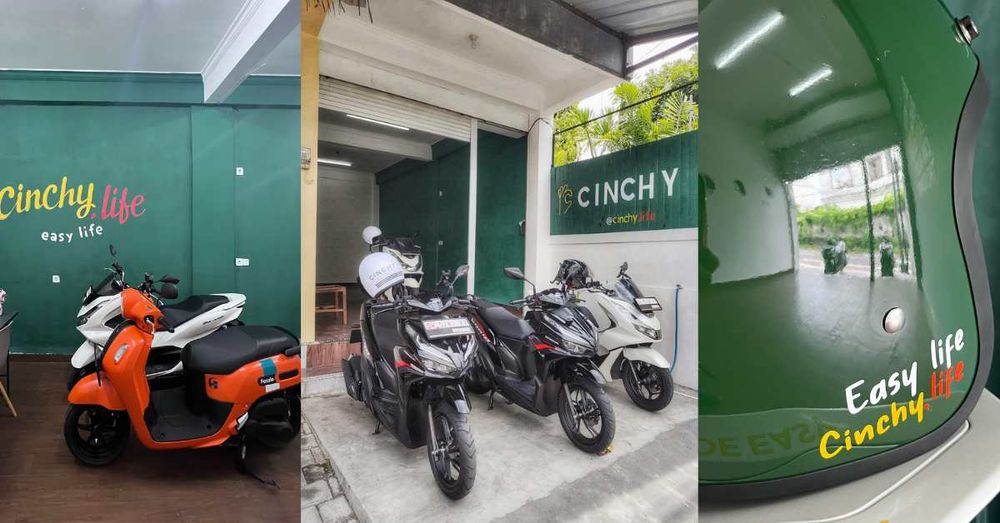
Booking your scooter before your flight can make the arrival process much simpler.
Instead of landing at Bali Airport and then spending time searching for a rental shop, you can arrange the scooter in advance and select where you want it delivered.
This is particularly useful for travelers who want to start their Bali itinerary immediately after arriving.
Cinchy focuses on making scooter rental straightforward for travelers who want to explore Bali independently.
Cinchy offers free scooter delivery and pickup at I Gusti Ngurah Rai International Airport and throughout the Seminyak area, making either location convenient for travelers starting their scooter trip.
The scooters are also regularly maintained before being rented out, so you can focus on your journey rather than spending your first day inspecting different rental options.
Another advantage is the availability of 24/7 customer support. If you have questions or need assistance during your rental, you can contact the Cinchy team at any time.
Cinchy divides its fleet into two categories: Compact and Comfort. The right choice depends on how much riding you plan to do, your preferred level of comfort, and your budget.
The Compact category is suitable for travelers who want an easy-to-handle scooter for everyday riding around Bali.
Models include:
Rental rates start from:
These scooters can be a practical choice for solo travelers or couples who mainly plan to explore Ubud, Seminyak, Canggu, and nearby areas.
For longer rides or travelers who prefer a larger scooter, the Comfort category includes:
Rental rates start from:
A Comfort scooter can be particularly appealing if your itinerary involves longer rides between different parts of Bali.
For example, if your trip includes Ubud, Kintamani, Canggu, Seminyak, and Uluwatu, having a more spacious scooter can make longer days on the road more comfortable.
Reserve your scooter with Cinchy before your flight, arrange your preferred airport pickup or delivery, and start exploring Bali at your own pace.
 travel tips
 hidden gems
 scooter guides
 riding tips
 bali guides
 cultural insight