1


Stay in Touch
Get the latest updates, special offers, and exclusive Cinchy perks straight to your inbox.


Jl. Plawa No.50, Seminyak, Kec. Kuta, Kabupaten Badung, Bali 80361

CALL US 24/7
(+62-851-7424-6249)
Copied!

We’re Here
Everyday
8:30 AM-9 PM WITA




Payment Partners


© 2026 CINCHY. ALL RIGHTS RESERVED.
Cinchy Blog / What to Do If Your Scoopy Motorcycle Lights, Horn, or Indicators Fail
Published: 06 Mar 2026

By Ulfah Alifah
Travel Enthusiast
Free Cancellation
24/7 Support
Insurance
Start Date - End Date
Start Time
End Time
Duration
0 Day(s)
A Honda Scoopy with a dead headlight, a silent horn, or non-working indicators is not just an inconvenience — it is a traffic violation and a serious safety risk on every road in Bali. Lights, horn, and indicators are not optional accessories. They are the communication systems your scooter uses to interact with every other road user around you. When any of them fail, your visibility, your ability to signal intent, and your legal standing on the road are all compromised. This guide covers every cause of lighting, horn, and indicator failure on the Honda Scoopy — how to diagnose each problem, how to fix it, what it costs at a Bali workshop in 2026, and what to do if it happens mid-rental.
Bali's climate is one of the harshest possible environments for motorcycle electrical systems. Two factors combine to accelerate electrical component degradation faster than most riders expect.
First, Bali's humidity — particularly during the wet season from October to April — promotes corrosion at every connector, plug, and socket in the scooter's wiring harness. Moisture wicks into connections through capillary action, oxidises the metal terminals, and increases electrical resistance until the circuit fails entirely.
Second, Bali's intense UV radiation and heat cause the insulation on wiring to dry out, crack, and become brittle over time. Cracked insulation leads to short circuits — where bare wire contacts the frame — which blow fuses and damage components.
The result is that electrical faults that might take 5 years to appear in a cooler, drier country can appear within 1 to 2 years of Bali operation if the scooter is not maintained properly. Knowing the causes and what to check first dramatically reduces the time spent on the side of the road.
Before diagnosing any individual component — whether the headlight, horn, or a turn signal indicator — always check the fuse box first. It takes two minutes and solves the majority of sudden, complete electrical failures.
Every Honda Scoopy has a fuse box located under the seat on the left side near the battery. It contains a set of blade fuses protecting each electrical circuit. A blown fuse causes complete, instant failure of every component on that circuit — no gradual fading, just an immediate, total cutout.
How to check the fuse box:
Fuse amperage guide for common Honda Scoopy circuits:
Replacement fuses cost IDR 2,000 to IDR 10,000 per fuse at any minimarket, motorcycle shop, or workshop. Keep a small assortment of 10A spare fuses in your under-seat storage at all times.
Important: If a new fuse blows again immediately after replacement, there is a short circuit in that wiring circuit. Do not keep replacing fuses — take the scooter to a workshop for wiring diagnosis before riding.
For a complete practical guide on fuse checks, battery inspection, and all common reasons a motorcycle electrical system fails — read our full article on why NMAX not starting? quick fixes and troubleshooting — the fuse diagnosis process applies directly to all Honda Scoopy models.
Despite modern Honda Scoopy models using LED headlights, some older carburetor-era Scoopy models still use halogen bulbs that have a limited lifespan. A halogen headlight bulb lasts approximately 500 to 1,000 hours of use — on a bike ridden 2 to 3 hours daily, this can mean replacement within 6 to 12 months.
Signs it is the bulb, not the fuse or wiring:
Fix:
A battery that is below 12V cannot supply adequate voltage to the lighting circuits. Headlights and brake lights become visibly dim at idle, and may flicker or cut out intermittently as electrical load fluctuates when the engine revs.
This is frequently the first visible symptom of a battery that is beginning to fail — the lights dim before the starter motor begins to struggle. Catching this early prevents a full breakdown.
Immediate check:
For a comprehensive guide on diagnosing weak battery symptoms — from dim lights to a slow starter — and the full step-by-step fix process including charge vs. replace decisions, read our article on signs of a weak motorcycle battery and how to fix it for riders in Bali.
Even with a healthy battery and intact fuse, a corroded connector between the wiring harness and the light unit can cause intermittent or complete failure. Vibration from riding gradually loosens push-fit connectors over time, and Bali's humidity corrodes the exposed metal terminals.
Quick check: Locate the connector behind the headlight or under the tail unit. Unplug and re-plug it firmly. Look for green corrosion on the pins. If present, clean with a dry cotton swab or a drop of contact cleaner spray.
Fix: Connector cleaning — IDR 15,000 to IDR 35,000 at a workshop. Connector replacement if terminals are too corroded to restore — IDR 25,000 to IDR 75,000.
The regulator-rectifier converts AC current from the alternator into DC current for the battery and electrical systems, and regulates voltage to prevent overvoltage damage. When it fails, it can either under-supply the system (causing dim, failing lights) or over-supply it (causing bulbs to blow repeatedly).
If your Scoopy blows bulbs and fuses repeatedly and in rapid succession — particularly after riding — the regulator-rectifier is a strong suspect. Replacement requires workshop diagnosis and costs IDR 150,000 to IDR 350,000 for part and labour.
For a full service cost breakdown covering all electrical components across Bali's Honda workshops — read our guide on motorcycle services in Bali: types, costs, and duration guide.
As covered above, the horn circuit fuse is the first and easiest thing to check. A blown horn fuse causes instant, complete silence with no gradual fading.
A battery below approximately 11.5V cannot supply adequate current to the horn coil. The horn may produce only a faint, muffled sound — or no sound at all.
The horn relay completes the high-current circuit from the battery to the horn unit when the horn button is pressed. A failing relay clicks but does not complete the circuit. Swap it with another relay of the same type in the fuse box to test — if the horn works after the swap, the relay is the fault.
The horn unit itself — the disc-shaped component mounted on the frame behind the front panel — can fail from moisture ingestion, physical impact, or age. A broken diaphragm inside the horn causes either no sound or a rapid clicking rather than a clear tone.
Horn unit replacement: IDR 35,000 to IDR 150,000 depending on OEM or aftermarket. A 15-minute workshop job.
In Bali's traffic culture, the horn is a proactive communication tool used daily — before blind corners, before overtaking, and when navigating narrow gang roads. A silent scooter in Bali traffic is an invisible scooter — and that increases accident risk significantly.
Short, light horn taps — not prolonged blasts — are the correct Bali style. Never use a horn near religious ceremonies, temples, or during ceremonial processions. For a full guide on horn etiquette and all the unwritten road rules that define Bali's riding culture, read our article on riding etiquette in Bali: how to stay comfortable and respected on the road.
A single indicator that does not flash — while the others work correctly — is almost always a blown bulb or failed LED in that specific indicator unit. On older Scoopy models with incandescent indicator bulbs, a failure in one bulb causes the remaining indicators on the same side to flash faster than normal — a phenomenon called "hyper flashing" — which makes the fault easy to spot.
Replacement cost per indicator bulb: IDR 10,000 to IDR 30,000
LED indicator replacement: IDR 35,000 to IDR 100,000 per unit
If all four indicators fail simultaneously, the indicator circuit fuse has blown. Check the fuse box first before diagnosing further.
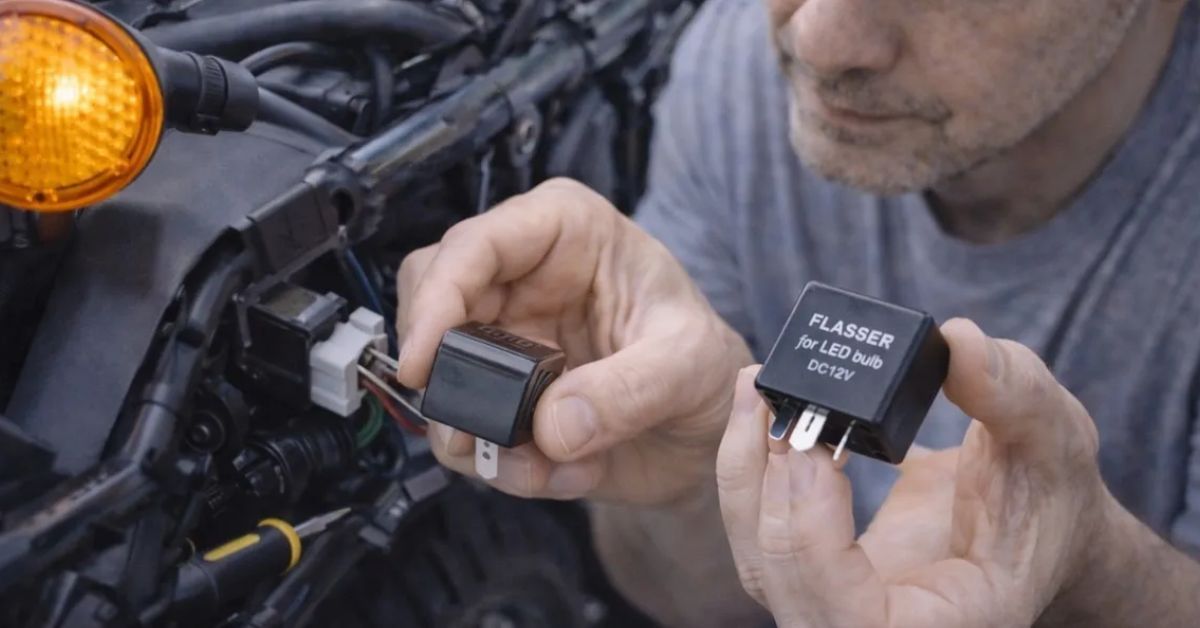
The flasher relay controls the on-off timing that creates the blinking indicator signal. When the flasher relay fails, indicators either stay on continuously without flashing, do not light up at all, or flash at an abnormal speed.
How to locate: The flasher relay is typically found in the relay cluster near the battery or under the front panel. It makes an audible clicking sound when working correctly.
Replacement cost: IDR 25,000 to IDR 75,000 for the relay unit.
The indicator stalk on the left handlebar switch cluster contains small internal contacts that corrode from moisture and repeated use. Corroded contacts cause intermittent or complete indicator failure from the switch itself — the light units are fine, but the signal never reaches them.
Fix: Switch cleaning with contact cleaner — IDR 15,000 to IDR 35,000 at a workshop. If the contacts are too corroded to restore, the handlebar switch unit is replaced — IDR 75,000 to IDR 200,000.
On Honda Scoopy models with keyless ignition (2018 and onwards), the smart key ECU manages multiple electrical circuits. A smart key system in a fault state or anti-theft lock mode can cut power to auxiliary circuits — including indicators — as part of its security response.
If all electrical accessories fail simultaneously alongside indicators — and the smart key indicator on the dashboard shows an error — the smart key system is the likely cause rather than individual component faults.
For the complete guide on every Scoopy smart key fault type and fix — including model-specific solutions for 2023, 2024, and 2025 Scoopy variants — read our article on Scoopy smart key 2023–2025 models not working and how to fix them.
For a fast, practical guide covering all common smart key problems with step-by-step solutions — read our article on Scoopy smart key not working: quick fixes and solutions.
This is a point that many riders underestimate. Riding with a non-functional headlight, a broken tail light, or non-working indicators is a traffic violation under Indonesian traffic law (UU Nomor 22 Tahun 2009).
Fines for lighting violations in Bali:
Beyond the fine, riding with failed lights is precisely the kind of defect that affects insurance claim outcomes. If you are involved in an accident and the investigation finds that your lights or indicators were not functioning at the time, your insurance claim — including Cinchy's rental insurance — can be partially or fully voided on grounds of vehicle defect.
For a full reference on all documents you need to carry while riding in Bali — including what traffic police check during stops — read our guide on essential documents to carry when riding in Bali.
Every electrical failure that strands a rider — or results in a fine — could have been caught by a 60-second pre-ride check. Make this check non-negotiable:
For the complete pre-ride motorcycle inspection checklist — covering electrical, mechanical, and safety checks — read our full guide on what to check before you ride a motorcycle in Bali.
And for the specific pre-rental checklist — covering exactly what to check and document before accepting any Cinchy scooter — read our guide on things to check before renting a scooter in Bali.
A headlight failure in daylight is an inconvenience. The same failure at night or in Bali's heavy monsoon rain is a critical emergency.
In Bali's wet season, a scooter without working headlights becomes nearly invisible to oncoming drivers on the many unlit rural roads between Ubud, Kintamani, Bedugul, and Uluwatu. Rain reduces visibility further, and without a functioning tail light, vehicles behind you cannot see your scooter until they are dangerously close.
Non-working indicators in rain compound the risk. Wet-weather lane changes without visible signals in Bali's fast-moving traffic increase collision risk dramatically. For a full set of wet-season riding safety practices — including visibility habits, appropriate speed, and road surface awareness — read our guide on essential tips for safe scooter riding during Bali's rainy season.
If any electrical fault develops while riding at night or in rain, pull over immediately at the nearest lit, safe location. Do not attempt to continue riding to your destination.
If a light, horn, or indicator fails during your Cinchy rental, contact the team immediately:
Cinchy's support team will guide you through a quick remote check — fuse inspection first, then component-by-component — and determine whether a technician needs to be dispatched or whether the fix is something simple you can confirm yourself.
Do not ride the scooter at night with a failed headlight. Pull over and wait for Cinchy's team to resolve the situation, or arrange alternate transport to your accommodation while Cinchy handles the scooter. Riding with a known defect — particularly one that is a legal violation — can affect your insurance coverage if an incident occurs.
Every Cinchy scooter is checked on all electrical systems before delivery — lights, horn, and indicators are tested as part of the standard pre-delivery inspection. An electrical fault that occurs during the rental is Cinchy's responsibility to fix at no cost to you, provided it is not the result of physical damage caused during the rental.
For the complete guide on every scenario where Cinchy's support team steps in — from electrical faults to mechanical breakdowns to accidents — read our article on what to do if your Cinchy scooter breaks down.
Simple electrical repairs — fuse replacement, bulb replacement, and indicator relay swaps — can be done at any general motorcycle workshop (bengkel motor) across Bali. These repairs are fast, inexpensive, and within the capabilities of all roadside mechanics.
For more complex electrical diagnosis — such as regulator-rectifier faults, wiring harness shorts, or smart key ECU issues — seek out a Honda AHASS (Astra Honda Authorized Service Station). AHASS workshops have Honda-specific diagnostic scan tools that read electrical fault codes directly from the ECU — the fastest and most accurate way to diagnose intermittent or complex faults.
For a complete guide on finding, evaluating, and choosing a trusted repair workshop anywhere in Bali — including tips on what to ask and what to avoid — read our practical guide on how to find a scooter repair near you in Bali.
For Honda AHASS workshop locations, service cost benchmarks, and booking guidance across Bali — read our full article on motorcycle repair dealers in Bali for Honda.
Quick cost reference for the most common electrical repairs at Bali workshops:
The overwhelming majority of light, horn, and indicator faults are resolved by a single fuse or bulb replacement — costing under IDR 30,000 and taking under 15 minutes. The diagnostic habit of checking the fuse box first saves almost every rider a wasted trip to a workshop for a problem they could have fixed themselves in two minutes.
Your Scoopy's lights, horn, and indicators are not optional extras — they are the systems that make you visible, communicative, and legal on Bali's roads. The five-minute daily electrical check catches faults before they become fines, accidents, or stranded-on-the-road emergencies. When a fault does appear, the fuse box is always the first stop — and a trusted Bali workshop fixes almost everything else in under 30 minutes.
Cinchy delivers every Honda Scoopy with all electrical systems confirmed functional. You ride knowing that your lights are on, your horn works, and your indicators are signalling — from your first metre to your last.
👉 Explore Cinchy Life's Honda Scoopy fleet — fully electrically inspected before every delivery:
Explore Cinchy Life →
👉 Book your Honda Scoopy now — working lights, horn, indicators, and 24/7 support included:
Book Your Scoopy →
 travel tips
 hidden gems
 scooter guides
 riding tips
 bali guides
 cultural insight